The Science of Skin
Your skin is a living organism. It has working parts — just like your heart, your kidneys, your lungs. We know we need to keep those organs functioning. We drink water, we eat well, we exercise. But nobody tells us what is inside our skin, how it works, or what it actually needs to stay healthy, clear, and resilient.
Instead we are sold creams that smell beautiful, packaged in promises, and filled with synthetic chemicals or fragrance. Or we pay a fortune for products that contain so little of the active ingredients that matter that they cannot possibly make a measurable difference. We deserve better than that. Our skin deserves better than that.
This page is about what is actually inside your skin — the molecules that keep it firm, hydrated, clear, and alive — and what the science says happens when they start to run low.
Collagen -
the structure your skin is built on
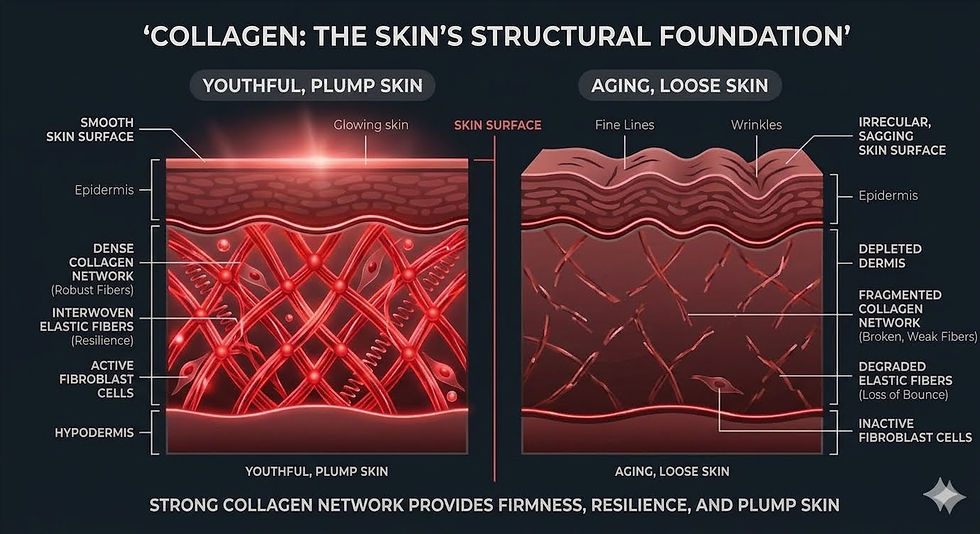
Collagen is the most abundant protein in the human body. In the skin, it forms a dense network of fibres in the dermis — the layer beneath the surface — that gives skin its firmness, its structure, and its ability to hold its shape. Think of it as the internal scaffolding. When it is intact and strong, the surface above it is smooth and supported. When it degrades, the surface collapses inward.
Collagen production peaks in your twenties. From that point, it declines at approximately 1% per year. By your forties, the rate of breakdown consistently outpaces the rate of production. UV radiation accelerates this — it activates enzymes called matrix metalloproteinases that actively degrade collagen fibres, which is why sun-exposed skin ages faster than protected skin.
The visible result is exactly what you would expect: lines deepen, contours soften, and skin loses the ability to hold its shape. This is not mysterious. It is structural — and it is measurable.
What the science says can help: ingredients that activate the same gene expression pathways as retinol — stimulating collagen production in skin cells — without retinol's well-documented side effects of inflammation, photosensitivity, and peeling. Bakuchiol is one such ingredient. A landmark randomised double-blind trial published in the British Journal of Dermatology compared bakuchiol directly against retinol over twelve weeks. Both produced statistically significant improvements in wrinkle surface area and skin firmness. The bakuchiol group reported no adverse effects. Additional published research confirms that bakuchiol stimulates types I, III, and IV collagen production in human dermal fibroblasts — the cells responsible for producing the structural proteins that keep skin firm.
The Sacred Skin Botanicals Bakuchiol Collagen Booster Serum is formulated around this science — delivering bakuchiol through two sources simultaneously, alongside caffeine, which published research confirms inhibits the enzymes that degrade existing collagen. It addresses collagen, where the problem actually begins: at the cellular level, where collagen is both made and lost.
Source: British Journal of Dermatology 2019 — Bakuchiol: a retinol-like functional compound that regulates skin differentiation. Randomised double-blind trial.
Source: Cosmetics 2025, 12(4), 129 — Skin Aging and Type I Collagen: A Systematic Review. MDPI.

Hyaluronic Acid —
the molecule that holds water in your skin.
We are told to drink water. And we should. But drinking water does not directly hydrate the skin — the skin has its own hydration system, and at the centre of it is a molecule called hyaluronic acid.
Hyaluronic acid is not a skincare invention. It is naturally present in your skin, your joints, and your eyes. Its specific function is to hold water — one molecule of hyaluronic acid can bind up to one thousand times its own weight in moisture. It is the reason young skin looks plump, bounces back when pressed, and has that quality of being lit from within that has nothing to do with pigmentation and everything to do with water content within the skin layers.
Published research confirms that hyaluronic acid loss begins at age 25. It does not vanish overnight — it depletes gradually, shifting from the upper layers of the skin into the deeper layers, leaving the surface progressively drier, less elastic, and more vulnerable to the fine lines that dehydration creates. By midlife, this depletion is significant and its effects are visible.
Molecular weight determines where hyaluronic acid works. High molecular weight hyaluronic acid cannot penetrate the skin's surface — it forms a conditioning film on top that prevents water loss. Low molecular weight hyaluronic acid is small enough to penetrate into the deeper epidermal layers, where it draws and holds moisture at the source. Using both simultaneously means the skin receives hydration at every level at once.
The Sacred Skin Botanicals Skin Clarity System addresses hyaluronic acid depletion directly — dual-weight hyaluronic acid runs through the system, working at the surface and within the deeper layers simultaneously. Hydration and clarity are not separate goals in this system. They are the same goal. Clear skin is hydrated skin. Hydrated skin is clear skin.
Source: PMC 2022 — Benefits of topical hyaluronic acid for skin quality and signs of skin aging. pmc.ncbi.nlm.nih.gov/articles/PMC10078143/
Source: Journal of Cosmetic Dermatology 2025, PMC11731322 — The Effect of Hyaluronic Acid on Skin Aging: A Systematic Review and Meta-Analysis.
Pigmentation —
when the skin's colour system loses its balance.

Age spots, dark patches, and uneven skin tone are not simply cosmetic concerns. They are the visible result of a biological process — melanin overproduction — that has gone out of regulation.
Melanin is the pigment that gives skin its colour and provides natural protection against UV radiation. It is produced by cells called melanocytes through a process driven by an enzyme called tyrosinase. When that process runs normally, melanin is distributed evenly. When it is triggered repeatedly by sun exposure, hormonal changes, or accumulated skin damage, it overproduces in specific areas — settling into the skin as the spots and patches that are so difficult to shift.
Addressing pigmentation requires interrupting the melanin pathway at multiple points simultaneously. Vitamin C at meaningful concentrations inhibits tyrosinase and reduces melanin production while also providing powerful antioxidant protection at the skin's surface. Tranexamic Acid works at a different point in the pathway — blocking the signals that trigger melanocyte activity. Niacinamide inhibits the transfer of melanin to the skin's surface cells. Alpha Arbutin provides additional tyrosinase inhibition. Used together, these actives address the problem from multiple angles at once — which is why a properly constructed system consistently outperforms any single brightening ingredient.
The Sacred Skin Botanicals Skin Clarity System is built on exactly this multi-pathway approach. The system was formulated to address pigmentation and hydration together — because skin that is clearing also needs to be hydrated, protected, and supported in its renewal. Clarity without hydration is incomplete. This system delivers both.
Source: Journal of Clinical and Aesthetic Dermatology — Tranexamic Acid in Dermatology: A Review. Widely accepted in cosmetic science.
Coenzyme Q10 —
the energy your skin cells run on.
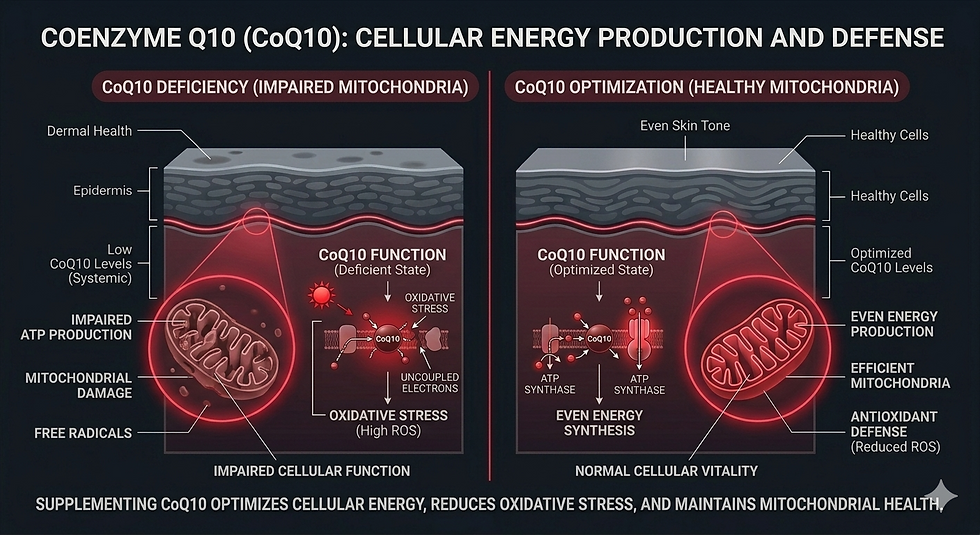
Every cell in your body needs energy to function. In skin cells, that energy is produced inside the mitochondria — the structures within each cell that convert nutrients into the fuel cells use to repair, renew, and maintain themselves. Coenzyme Q10 is central to that process. It is present in every skin cell, and it plays two roles: powering the mitochondria and acting as a potent antioxidant that neutralises the free radicals generated by UV radiation and pollution.
CoQ10 levels in the skin decline measurably with age and UV exposure. As they fall, two things happen at once. Skin cells have less energy for the repair and renewal that keeps skin looking healthy. And the skin's antioxidant defence weakens — leaving it increasingly vulnerable to the oxidative damage that breaks down collagen, disrupts cellular function, and accelerates every visible sign of ageing. The result is skin that looks tired, loses firmness, develops uneven texture, and stops recovering the way it once did.
Published clinical research from the Journal of Clinical and Aesthetic Dermatology confirms that topically applied CoQ10 replenishes cellular CoQ10 levels — not just at the surface but in the deeper skin layers. Studies show measurable reductions in wrinkle depth and improvements in skin texture with consistent use. CoQ10 also inhibits collagenase — the enzyme that degrades collagen — providing a protective effect on skin structure alongside its energy and antioxidant functions.
The Sacred Skin Botanicals CoEnzyme Q10 System was formulated to address this depletion directly. Two serums — one with Prickly Pear and Sea Buckthorn, one with Ginseng — work at different levels alongside CoQ10. A cream completes the system. All three products contain CoQ10. Together, they replenish the cellular energy environment, protect against oxidative damage, and support the conditions in which healthy skin maintains itself.
Source: Journal of Clinical and Aesthetic Dermatology 2024 Aug;17(8):50-55 — The Role of Coenzyme Q10 in Skin Aging and Opportunities for Topical Intervention.
a paragraph.
What this means to your skin
Nobody tells us what is inside our skin. We know we have a heart that needs to pump blood, kidneys that need to filter, lungs that need to breathe. We understand those systems because we have been taught them. But our skin — the largest organ we have, the one most exposed to the world — is handed over to marketing departments and fragrance chemists, and we are left without the knowledge to make informed decisions about what we put on it.
Collagen gives skin its structure. Hyaluronic acid gives it hydration. CoQ10 gives its cells the energy to function and the protection to survive. These are not ingredients chosen because they look impressive on a label. They are molecules that are native to your skin — present when you are young, depleted as you age, and replaceable to a meaningful degree when the right ingredients are applied consistently and at concentrations that the science supports.
The results from good skincare are real. They are not miracles. No topical product reverses decades of depletion in weeks. What well-formulated skincare does — backed by peer-reviewed evidence — is slow further degradation, support the skin's own renewal processes, and restore what has been lost to a measurable and visible degree. That is an honest claim. It is one the science supports. And it is the standard every Sacred Skin Botanicals formulation is held to.
Sacred Skin Botanicals products are independently formulated cosmetic products. They are not medicines and make no therapeutic claims. All hero ingredients are named for their documented cosmetic function. Formulations are INCI-compliant with labelling that accurately reflects what is inside each product.